
admin – gstcomplianceexperts

Difference Between GSTR-1 and GSTR-3B

Understanding the difference between GSTR-1 and GSTR-3B is essential for every GST-registered business in India. These two GST returns serve different purposes, and filing them correctly helps businesses stay compliant, avoid penalties, and maintain accurate tax records.

GSTR-1 is a return used to report outward supplies, meaning the sales made by a business during a tax period. GSTR-3B, on the other hand, is a summary return used to declare tax liability, claim eligible Input Tax Credit, and pay GST to the government.

For businesses that want accurate and timely compliance, professional support can make the process easier. You can explore our 

GST return filing services

 for complete assistance with GST compliance.

What is GSTR-1?

GSTR-1 is a return that contains invoice-wise details of outward supplies made by a registered taxpayer. It includes sales to registered customers, unregistered buyers, debit notes, credit notes, and other supply-related details.

This return helps the recipient see their purchase details in GSTR-2A or GSTR-2B, which is important for availing Input Tax Credit. In simple terms, GSTR-1 ensures that your sales are reported correctly to the GST system and to your buyers.

What is GSTR-3B?

GSTR-3B is a monthly or quarterly summary return filed by GST-registered taxpayers. It is used to declare total sales, eligible Input Tax Credit, reverse charge liabilities, and the final GST payable for the period.

Unlike GSTR-1, GSTR-3B does not require invoice-level details. It is a consolidated return where the taxpayer self-assesses the tax liability and pays the due amount to the government.

Key Differences

Basis GSTR-1 GSTR-3B
Purpose Reports outward supplies and sales details  Declares tax liability and pays GST 
Format Invoice-wise detailed return  Summary return 
Tax Payment No direct tax payment  Tax payment is made through this return 
Impact on Buyer Helps populate buyer’s credit records  No direct buyer-level reporting 
Detail Level High-detail reporting  Consolidated figures only 

Filing Due Dates

For regular taxpayers, GSTR-1 is generally filed by the 11th of the following month, while GSTR-3B is generally filed by the 20th of the following month. Quarterly filing options may apply to eligible small taxpayers under GST rules.

Missing deadlines can lead to late fees, interest, and compliance issues. That is why businesses should keep invoices, purchase records, and reconciliation ready before filing both returns.

Why Reconciliation Matters

GSTR-1 and GSTR-3B must match as closely as possible because both returns reflect the same business activity in different formats. If there is a mismatch, it may create problems in tax reporting, Input Tax Credit claims, and compliance reviews.

Reconciliation helps identify missing invoices, excess tax reporting, incorrect ITC claims, and clerical mistakes before filing. This is especially important for businesses with large transaction volumes or multiple branches.

Common Mistakes to Avoid

Many businesses make avoidable errors while filing GSTR-1 and GSTR-3B. These include mismatched sales figures, incorrect tax classification, missed credit notes, wrong invoice entries, and delay in filing returns.

Another common issue is treating both returns as interchangeable. In reality, GSTR-1 and GSTR-3B are different forms with different reporting requirements, so each one must be prepared carefully.

Professional Filing Support

GST return filing becomes easier when you have expert support to manage data verification, reconciliation, and timely submission. This reduces the risk of errors and helps your business remain GST compliant throughout the year.

At GST Compliance Experts, we help businesses with accurate GST return filing, reconciliation, and compliance support. If you need complete assistance, visit our 

GST return filing services page for expert help.

Conclusion

The difference between GSTR-1 and GSTR-3B lies in their purpose, format, and filing role. GSTR-1 reports outward supplies in detail, while GSTR-3B summarizes tax liability and is used for actual payment of GST.

Filing both returns correctly and on time is essential for smooth GST compliance. With the right filing support, businesses can avoid errors, reduce compliance risk, and keep their GST records clean.


Contact ‎‎+91-9667793597

🌐 Visit: https://gstcomplianceexperts.in/

GST Compliance Updates for E‑Commerce (2026)

The e‑commerce sector in India is growing fast, and GST rules are evolving to keep pace. In 2026, GST compliance for online sellers and platforms has seen several updates related to reporting, place of supply, TCS, return‑filing, and data‑sharing. This article explains the key GST compliance updates for e‑commerce (2026) and how they affect sellers on Amazon, Flipkart, Meesho, and other online marketplaces.

1. Tighter Reporting and Data‑Matching for E‑Commerce

One of the biggest themes in 2026 is greater data‑matching between GST and e‑commerce systems.

  • The GST portal now matches marketplace‑level sales data with GSTR‑1 and GSTR‑3B more actively.
  • Discrepancies between platform reports and GST returns can trigger SMS alerts, mismatches, or audit risk.
  • E‑commerce sellers must ensure that each invoice and return line correctly matches the platform‑generated sales register.

This means reconciliation between Amazon/Flipkart‑level reports and GST data is no longer optional; it is a core compliance task.

2. Place of Supply and Multi‑State Rules

Place‑of‑supply rules for e‑commerce have become stricter in 2026:

  • Inter‑state supplies (goods shipped from one state to another) are clearly identified and taxed under IGST.
  • Sellers must correctly map pin‑code to state and apply the correct GST rate and form for each destination.
  • FBA, cross‑state fulfilment, and multi‑warehouse models must show state‑wise GST treatment in records and GST returns.

Wrong place‑of‑supply or misclassification can create IGST vs CGST‑SGST mismatches, increasing scrutiny.

3. TCS and Tax Collection at Source Updates

Tax Collection at Source (TCS) remains a critical compliance area for e‑commerce platforms and sellers:

  • E‑commerce operators still collect TCS from sellers on every taxable supply made through the platform.
  • Sellers must reconcile TCS with GST portal data (GSTR‑2B / GSTR‑2A) and claim the correct credit.
  • In 2026, the department is more likely to verify TCS‑related ITC claims during audits or mismatch checks.

Sellers must keep TCS‑reconciliation logs and respond promptly if there are TCS‑related alerts.

4. Return‑Filing and Structured E‑Commerce Reporting

GST return‑filing requirements for e‑commerce sellers have also evolved:

  • GSTR‑1 now demands more structured reporting of e‑commerce supplies, including platform‑wise or marketplace‑wise breakout where applicable.
  • GSTR‑3B requires cleaner matching of tax liability and ITC with marketplace data.
  • Quarterly filers under QRMP must ensure that e‑commerce sales data is correctly mapped to each quarter.

Sellers using automated billing or accounting software must update their setups to match these 2026‑style GST requirements.

5. Multi‑State Sellers and GST Registration Updates

For sellers with warehouses, fulfilment centres, or suppliers in different states:

  • The rules around multi‑state registration and GSTIN alignment have become clearer in 2026.
  • Sellers may need multiple GST registrations if they have fixed places of business or warehouses in other states.
  • Each state‑wise GSTIN must correctly report in‑state and inter‑state supplies made from that location.

Proper inventory‑location mapping and GSTIN‑wise reporting help avoid inter‑state mismatches and notices.

6. Aggregator‑Specific GST Compliance Updates

Aggregator models (ride‑hailing, professional services, healthcare, beauty, etc.) have seen some GST‑specific updates:

  • The platform vs service‑provider GST treatment has been clarified in recent notifications.
  • Commissions, convenience fees, and service‑fees are now more clearly mapped to service‑category‑wise GST treatment.
  • Aggregators must ensure TCS‑type or service‑tax compliance is correctly applied and reported.

These changes reduce ambiguity but increase the need for platform‑wise GST structuring.

7. Increased Scrutiny and Risk‑Based Checks

2026 has brought more risk‑based checks for e‑commerce sellers:

  • Large‑volume sellers, high‑ITC‑to‑turnover ratios, or multiple GSTINs with similar SKUs are flagged more easily.
  • Frequent returns‑mismatches, missing returns, or TCS‑reconciliation gaps can trigger departmental or audit‑based scrutiny.
  • Even small sellers are not immune if their GST profile shows recurring mismatches.

To stay safe, sellers should reconcile monthly, fix mismatches early, and keep full documentation.

8. How E‑Commerce Sellers Can Stay Compliant in 2026

To align with GST compliance updates for e‑commerce in 2026:

  • Reconcile marketplace data (Amazon, Flipkart, etc.) with GST returns monthly.
  • Map place‑of‑supply and GST rates correctly for each pin‑code and state.
  • Reconcile TCS with GST portal data and respond to any TCS‑related alerts.
  • Update or align software and accounting tools to match 2026‑style GST reporting.
  • Seek GST compliance support for complex multi‑state, multi‑platform, or high‑volume operations.

GST‑compliant reporting not only avoids penalties but also builds trust with platforms, banks, and buyers.

Final Takeaway

GST compliance updates for e‑commerce in 2026 focus on stricter data‑matching, clearer place‑of‑supply rules, structured return‑filing, and tighter TCS‑compliance. For sellers on Amazon, Flipkart, and other e‑commerce platforms, these changes mean:

  • Closer alignment between platform data and GST returns.
  • More attention to inter‑state supplies, multi‑state GSTINs, and TCS‑reconciliation.
  • Higher risk of scrutiny if data mismatches or late filings continue.

By adapting to these 2026 GST compliance updates and, if needed, working with GST compliance experts, e‑commerce businesses can stay compliant, avoid penalties, and scale confidently on online platforms.


Contact ‎‎+91-9667793597

🌐 Visit: https://gstcomplianceexperts.in/

GST Compliance for E‑Commerce Platforms (Amazon, Flipkart, etc.)

If you sell on Amazon, Flipkart, Meesho, JioMart, or other e‑commerce platforms, GST compliance is not optional. E‑commerce businesses face stricter GST rules, higher scrutiny, and more complex return‑filing requirements than many offline traders. This guide explains GST compliance for e‑commerce platforms and how marketplace sellers and aggregators can stay compliant in 2026.

Why GST Is Strict for E‑Commerce

The GST law treats e‑commerce platforms and sellers separately and carefully because:

  • They facilitate large‑volume, inter‑state, and multi‑state supplies.
  • They create complex GST‑ITC chains between suppliers, platforms, and buyers.
  • They are easy to track via centralised data, so departmental checks are frequent.

That is why even small sellers on Amazon or Flipkart must follow GST rules more carefully than some offline businesses.

Who Must Register – Sellers vs Platforms

Both sellers and the platforms may need GST registration:

  • Sellers on e‑commerce platforms must register if their aggregate turnover crosses ₹20 lakh (₹40 lakh for special states) or they make inter‑state supplies.
  • Amazon, Flipkart, and other e‑commerce operators must register even if their turnover is low, because they are e‑commerce operators under GST law.
  • Aggregators (like Ola, Urban‑Company, Swiggy‑type models) also have their own GST registration and compliance rules.

Knowing your category (small seller, professional seller, or platform) is the first step to correct compliance.

Tax Collection at Source (TCS) for E‑Commerce Platforms

GST law mandates Tax Collection at Source (TCS) for e‑commerce models:

  • The e‑commerce operator (marketplace) collects a small TCS from the seller on every taxable supply made through its platform.
  • TCS is deposited separately and shown in the operator’s GST returns.
  • Sellers claim credit for TCS in their GST returns, just like any other tax paid.

For Amazon or Flipkart sellers, this means that TCS deductions and reconciliations become a regular part of GST compliance.

GST Returns for E‑Commerce Sellers

E‑commerce sellers usually file the same core GST returns as other normal taxpayers, but with extra attention:

  • GSTR‑1 – Must show all marketplace sales with correct HSN, rate, and place of supply.
  • GSTR‑3B – Needs careful matching with marketplace data and TCS details.
  • GSTR‑9 / GSTR‑9C – Annual return and reconciliation become critical because of high‑volume, multi‑state sales.

Reconciling platform‑generated sales reports with GST portal data is essential to avoid mismatches and notices.

Place of Supply and Inter‑state Rules

For e‑commerce sales, place of supply is very important:

  • When goods are shipped from one state to another, it is inter‑state supply and taxed differently.
  • GST rates, IGST application, and HSN classification must be correct for each pin‑code‑based shipment.
  • Many e‑commerce sellers use automated systems to map pin‑code to states and apply the correct GST rate.

Wrong place‑of‑supply or state mapping can create IGST vs CGST‑SGST mismatches and future scrutiny.

Multiple GSTINs and Multi‑State Sellers

If an e‑commerce seller has warehouses or suppliers in multiple states, or is fulfilling orders from different states:

  • You may need multiple GST registrations (GSTINs).
  • Each state‑wise GSTIN must file returns correctly for in‑state and inter‑state supplies made from that state.
  • Centralised accounting and clear inventory‑location mapping are necessary for clean compliance.

Multi‑state e‑commerce operations are common for Amazon FBA and Flipkart Fulfilment sellers.

GST Compliance for Aggregators (Service‑Based E‑Commerce)

Aggregators follow slightly different GST rules:

  • The aggregate platform is typically treated as the supplier of services, not just an intermediary.
  • Service‑providers on the platform must still be GST‑registered if they cross the threshold.
  • GST is charged on service fees, convenience charges, and commissions as per applicable rules.

Aggregators in healthcare, beauty, ride‑hailing, or professional services must structure their GST compliance carefully to avoid disputes.

Common GST Compliance Issues for E‑Commerce Sellers

Many e‑commerce sellers face GST problems because of:

  • Mismatch between marketplace reports and GST returns.
  • Wrong HSN or incorrect GST rate on items.
  • Missing inter‑state supply identification in invoices.
  • Not reconciling TCS with GST portal data.
  • Delayed or missed GST return filing due to high‑volume, fast‑moving sales.

These issues can trigger SMS alerts, notices, or audit risk even for honest sellers.

How Professionals and GST Compliance Experts Help

GST compliance experts can simplify GST for e‑commerce sellers and platforms:

  • Help set up correct GST registration across states and categories.
  • Advise on IGST vs CGST‑SGST treatment for different supply scenarios.
  • Assist in reconciling marketplace data with GST returns (GSTR‑1, GSTR‑3B, GSTR‑9).
  • Guide on TCS compliance and response to any GST notices related to platforms.

For MSMEs, traders, freelancers, and service providers selling on Amazon, Flipkart, and other e‑commerce sites, this support reduces errors and keeps GST compliance smooth.

Final Takeaway

GST compliance for e‑commerce platforms and sellers is more complex but manageable if structured correctly. Key areas include:

  • Correct GST registration for sellers and platforms.
  • Proper handling of TCS and reconciliations.
  • Accurate place‑of‑supply and GST rate application for multi‑state orders.
  • Regular reconciliation between marketplace data and GST returns.

By following these rules and, if needed, working with GST compliance experts, e‑commerce businesses can stay compliant, avoid penalties, and scale smoothly on platforms like Amazon and Flipkart.


Contact ‎‎+91-9667793597

🌐 Visit: https://gstcomplianceexperts.in/

Types of GST Notices – SRC, SCN, DRC, and Others

If you are GST‑registered in India, you may eventually receive a GST notice on the GST portal. These notices come in different forms—Show Cause Notice (SCN), SRC, DRC, demand notices, and SMS‑based alerts—each with a specific purpose and compliance requirement. Understanding the types of GST notices helps you respond correctly instead of panicking or ignoring them.

What Is a GST Notice?

A GST notice is an official communication from the GST department pointing out a mismatch, default, or suspected non‑compliance in your GST records. Notices can be:

  • Electronic (shown on the GST portal).
  • Document‑based (formal show cause or demand notices).

Receiving a notice does not automatically mean heavy penalty; it usually means the department wants you to explain, correct, or pay certain amounts. Responding timely and accurately is key.

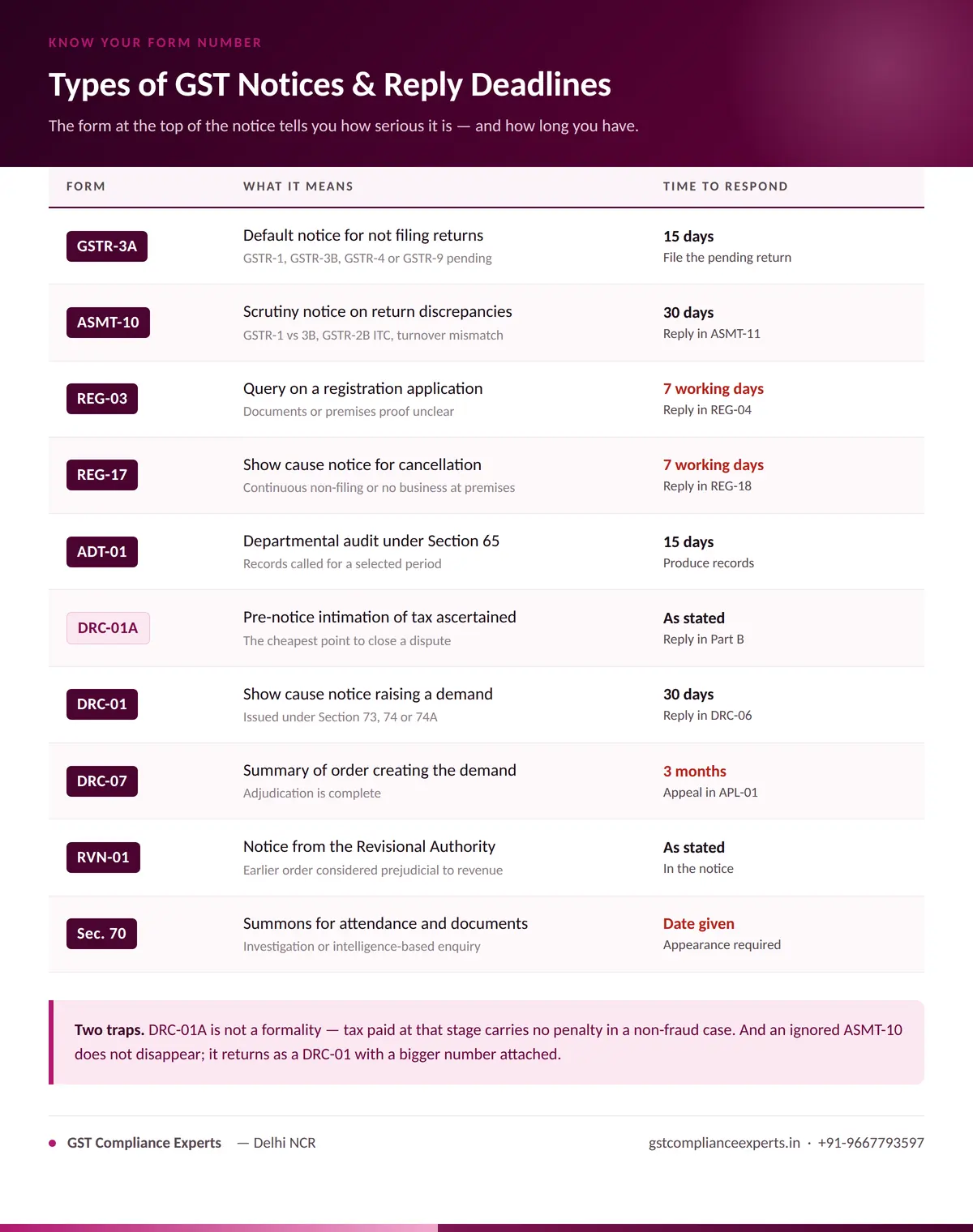
1. Show Cause Notice (SCN)

The Show Cause Notice (SCN) is the most common GST notice for substantive issues.

  • It asks you to “show cause” against a proposed demand or penalty.
  • Typically issued when the department finds mismatch in returns, excess ITC, or short‑payment of tax.
  • You are given around 30 days to reply with supporting documents and explanations.

An SCN may later lead to a demand notice or order if the reply is unsatisfactory or not filed on time.

2. System‑Generated or SRC‑Type Notices

GST portal often sends system‑generated communication or SRC‑style messages (Show‑Related Communication or similar alerts):

  • These are SMS or email alerts for:
    • Missed or late returns.
    • Outstanding tax liability.
    • Mismatch between GSTR‑1, GSTR‑3B, and GSTR‑9.
  • They act as early warnings, not formal SCN‑class notices.
  • Businesses should treat them seriously and file missing returns or reconcile records instead of ignoring them.

3. GST Demand Notices (DRC Series – DRC‑01, etc.)

DRC notices (DRC‑01, DRC‑03, etc.) are formal demand notices that ask for payment of tax, interest, or penalty.

  • DRC‑01 – Used to raise demand (tax, interest, penalty) after proper scrutiny or audit.
  • DRC‑03 – Used for recovery of demand if tax is not paid within the due date.
  • These notices typically:
    • Specify the amount of tax, interest, and penalty.
    • Mention the due date to pay or contest.
    • May be accompanied by attachment or recovery action if not complied with.

Ignoring demand notices can lead to bank account attachment, asset attachment, or credit‑score issues.

4. Additional or Additional Liability Notices

An Additional Liability Notice arises when:

  • The department detects extra tax payable after scrutiny or audit.
  • You have under‑paid, mis‑classified, or missed certain supplies.

This notice can be issued as part of SCN proceedings or as a separate communication, and it often links to ITC mismatches or wrong rate‑application.

5. GST Audit‑Based Notices

GST audits can also generate notices:

  • Statutory audit notices when the CA‑certified GSTR‑9C reveals short‑payment, wrong classification, or ITC issues.
  • Departmental‑audit notices after GST officers conduct a physical or virtual audit of your records.

These notices may not carry a separate “form” name but will still require a written reply, documents, and possible payment.

6. Notices for Non‑Filing or Delayed Returns

For businesses that miss GST return due dates, the department issues:

  • Return‑related reminders via SMS or email.
  • In some cases, notices under Section 46 or 47 of CGST Act, asking for explanation on delay.

Repeated non‑filing can lead to extra‑scrutiny, penalty, or even cancellation of GST registration in serious cases.

7. Special Notices – Arrest, Detention, and Seizure

In rare and serious cases of tax evasion or fraud, the department may issue:

  • Arrest notices.
  • Detention or seizure notices for goods or vehicles.

These are high‑severity proceedings and usually supported by strong documentary or audit evidence.

How to Respond to Different Types of GST Notices

The response strategy depends on the notice type:

  • For SCN / SRC‑style notices:
    • Read carefully, download full notice from GST portal.
    • Collect invoices, returns, bank proofs, and reconciliation reports.
    • Draft a clear, point‑wise reply and submit within the due date.
  • For DRC / demand notices:
    • Check if the calculated tax, interest, and penalty are correct.
    • Contest with proper reasoning if needed, or pay within the due date to avoid escalation.
  • For audit‑based or additional‑liability notices:
    • Co‑ordinate with your CA or GST expert to prepare audit‑linked replies and corrections.

In complex or high‑value cases, professional representation can reduce demand, penalty, or interest through proper arguments and documentation.

Why It Matters for MSMEs, Traders, and Service Providers

For MSMEs, traders, retailers, freelancers, and service providers, knowing the types of GST notices helps:

  • Spot early warnings (SRC, SMS alerts) and fix issues before they become big notices.
  • Differentiate between routine mismatches and serious evasion‑type proceedings.
  • Decide when to handle it yourself and when to involve a GST compliance expert.

A clean, proactive GST compliance profile greatly reduces the chances of harsh notices and supports smooth business growth.

Final Takeaway

In India, types of GST notices include:

  • Show Cause Notice (SCN) for mismatches and proposed demands.
  • System‑generated alerts or SRC‑type notices for missed returns or data mismatches.
  • DRC notices (DRC‑01, DRC‑03) for tax and penalty demands.
  • Additional liability and audit‑based notices for extra‑tax or audit‑linked issues.

By understanding what each notice means and responding correctly and on time, you protect your business from unnecessary penalties and keep your GST compliance profile clean.


Contact ‎‎+91-9667793597

🌐 Visit: https://gstcomplianceexperts.in/

Who Must Register for GST in India

GST registration is not optional for every business; certain entities and situations require mandatory registration, while others can register voluntarily. If you are starting or expanding a business in India, understanding who must register for GST helps you avoid penalties, notices, and compliance gaps. This guide explains the main categories of businesses that must register for GST and those who can choose to register.

Mandatory GST Registration – Basic Rule

The core GST law rule is simple: if your aggregate turnover crosses a specified limit, registration is mandatory. As of 2026:

  • Normal category states: ₹20 lakh in a financial year.
  • Special category states (Himalayan and North‑Eastern states): ₹40 lakh in a financial year.

Aggregate turnover includes all taxable supplies, exports, and inter‑state supplies but excludes GST. If your turnover exceeds these limits, your business generally must register for GST.

Businesses That Must Register – Inter‑State Suppliers

Even if turnover is below the threshold, some businesses are compelled to register because of their nature:

  • Suppliers making inter‑state taxable supplies (goods or services sold to other states), even if turnover is low.
  • Casual taxable persons (businesses without a fixed place of business in the state).
  • Non‑resident taxable persons (entities operating in India without a permanent presence).

For such businesses, the inter‑state or casual nature of supplies overrides the turnover limit, making GST registration mandatory.

E‑Commerce Operators and Aggregators

GST law treats e‑commerce operators and aggregators strictly:

  • E‑commerce platforms (that supply goods or services themselves) must register, even if turnover is modest.
  • Drivers, riders, service providers, or professionals working through aggregators must also be GST‑registered if they meet normal threshold rules.

Registration for e‑commerce is closely monitored because these businesses impact large‑scale ITC flow and tax compliance.

Service Providers Crossing the Threshold

For many professionals and service providers, the GST threshold still applies:

  • Advocates, CA firms, doctors, consultants, freelancers, and other service providers must register if their aggregate turnover exceeds ₹20 lakh (₹40 lakh for special states).
  • Services like consultancy, digital marketing, legal advisory, and IT services are fully taxable under GST.

Once registered, these service providers must file GST returns, issue GST‑compliant invoices, and handle input tax credit like any other GST taxpayer.

Businesses with Voluntary GST Registration

Even if your turnover is below the mandatory limit, you may choose voluntary GST registration for several reasons:

  • To claim input tax credit on business purchases.
  • To expand inter‑state trade or deal with GST‑registered clients who prefer billing with GSTIN.
  • To build a formal, GST‑compliant business profile that helps in bank loans, tenders, and partnerships.

Voluntary registration is common among small traders, startups, and freelancers who want the benefits of GST without being forced by turnover.

Businesses That Are Exempt or Not Required

Not every business must register for GST. Some common exemptions include:

  • Small businesses with turnover below the threshold and not making inter‑state supplies.
  • Specified exempt services listed in GST law (e.g., certain educational or health‑related services).
  • Composition dealers below the composition‑scheme threshold, who follow simplified GST rules instead.

However, exemptions can be complex; it helps to verify your category with a GST expert or official notifications.

Why Knowing Who Must Register Matters

Understanding who must register for GST in India is important because:

  • It helps you start GST compliance early, avoiding sudden notices after crossing the threshold.
  • It prevents penalties for late registration, missed returns, or incorrect invoicing.
  • It lets you plan your pricing and billing based on whether GST applies to your supplies.

For MSMEs, traders, professionals, and e‑commerce sellers, timely GST registration supports clean compliance and business growth.

Steps if You Must Register for GST

If your business falls under the “must register” category:

  1. Check your turnover and business activity to confirm GST applicability.
  2. Prepare documents like PAN, address proof, ID proof, bank details, and incorporation documents.
  3. Apply for GST registration online through the GST portal (gst.gov.in) in form GST REG‑01.
  4. Wait for approval and download your GSTIN once issued.
  5. Start issuing GST‑compliant invoices and filing the required returns from the effective date.

If you are unsure whether registration is mandatory or voluntary for your case, consulting a GST compliance expert can clarify your position and help you register smoothly.

Final Takeaway

So, who must register for GST in India?

  • Businesses with aggregate turnover crossing ₹20 lakh (₹40 lakh for special states) must register.
  • Inter‑state suppliers, e‑commerce operators, and service providers may be required even with lower turnover.
  • Many small businesses can also register voluntarily to access ITC and inter‑state trade benefits.

By knowing whether your business falls in the “must register” category and taking action early, you protect your business from compliance risk and set up a clean GST base for long‑term growth.


Contact ‎‎+91-9667793597

🌐 Visit: https://gstcomplianceexperts.in/

GST Audit Thresholds for Businesses in India

GST audit thresholds determine when a business must undergo a GST audit and file additional compliance forms. For many MSMEs, traders, and service providers, understanding these thresholds is critical to avoid penalties, notices, and last‑minute compliance surprises. This article explains the key GST audit thresholds for businesses in India and how they impact your compliance.

What Is the Main GST Audit Threshold?

The primary GST audit threshold in India is based on aggregate turnover in a financial year:

  • If your aggregate turnover exceeds ₹2 crore (₹200 lakh) in a financial year, your business may be subject to statutory GST audit.
  • The threshold is exclusive of GST and includes all taxable supplies made across India, not just one state.

This ₹2 crore limit is the main trigger that brings many businesses into the GST audit framework, especially those registered under the normal GST scheme (not composition dealers).

Who Must Undergo GST Audit?

Not all businesses crossing ₹2 crore automatically face a statutory audit. The main categories are:

  • Regular GST taxpayers whose aggregate turnover exceeds ₹2 crore and who are not under the composition scheme.
  • Such businesses must get their GST records audited by a Chartered Accountant or Cost Accountant and file GSTR‑9C (reconciliation statement and audit report) along with the annual GST return (GSTR‑9).

Composition‑scheme dealers are exempt from statutory GST audit, even if their turnover exceeds ₹2 crore. However, they can still be picked for departmental or risk‑based audit if anomalies are detected.

What Happens When You Cross the Threshold?

If your business crosses the ₹2 crore GST audit threshold:

  • You must prepare for GST audit by reconciling your books, GST returns, and ITC.
  • You must get a GST audit report prepared by a qualified CA or Cost Accountant.
  • You must file GSTR‑9C on the GST portal within the due date (usually along with GSTR‑9).

Missing or delaying the audit can lead to compliance issues, departmental scrutiny, and potential penalties, even if the underlying error is minor.

Departmental / Risk‑Based GST Audit Thresholds

Besides the statutory ₹2 crore threshold, the GST department can also audit any registered business if:

  • There are data mismatches between GSTR‑1, GSTR‑3B, and GSTR‑9.
  • Your input tax credit claims are unusually high compared to turnover.
  • The GST analytics system flags your returns for risk‑based scrutiny.

In such cases, turnover amount is not the only factor—compliance behavior, ITC pattern, and audit‑risk scores matter. That is why even businesses below ₹2 crore should maintain clean records.

Turnover Criteria for GST Audit

The term aggregate turnover is key for determining GST audit thresholds. It includes:

  • All taxable supplies (goods and services) made across India.
  • Plus exports and inter‑state supplies.
  • But excludes GST component from the value.

For businesses with multiple GSTINs under the same PAN, the turnover is usually aggregated PAN‑wise, which can push certain groups into the audit category even if individual units are small.

Why GST Audit Thresholds Matter for MSMEs

For MSMEs and small traders, crossing the ₹2 crore GST audit threshold is a turning point in compliance:

  • It signals that your business has grown enough to be systematically scrutinised.
  • It increases the need for professional accounting, proper record‑keeping, and timely GST filings.
  • It introduces audit‑year tasks like preparing for CA verification, gathering supporting documents, and filing GSTR‑9C.

Preparation before crossing the threshold can reduce audit stress and avoid negative findings.

How to Prepare for GST Audit at the Threshold

If your turnover is approaching or has crossed ₹2 crore, you should:

  • Reconcile your books with GST returns (sales, purchases, ITC).
  • Fix mismatches between GSTR‑1, GSTR‑3B, and GSTR‑9.
  • Organise invoices, e‑way bills, bank statements, and earlier returns for audit.
  • Engage a GST compliance expert or CA early to review your GST profile.

This proactive approach turns GST audit from a stressful event into a routine compliance checkpoint.

What If You Are Below the Threshold?

Even if your turnover is below ₹2 crore, you should not ignore GST audit risk:

  • System‑generated anomalies or high ITC‑to‑turnover ratios can still trigger scrutiny.
  • Missed or delayed GST returns create data mismatches that attract departmental attention.
  • Poor record‑keeping increases the chance of manual verification or inspection.

Treating every GST return like a potential audit trail keeps your business safe, regardless of the threshold.

How GST Compliance Experts Help Around Thresholds

GST compliance experts can help businesses before, at, and after crossing the GST audit threshold:

  • Track when your aggregate turnover is nearing ₹2 crore and advise on audit readiness.
  • Assist in reconciling returns and records for GSTR‑9 and GSTR‑9C.
  • Prepare or review the GST audit report and respond to any audit‑based objections.
  • Guide you on maintaining clean records even if you are below the statutory threshold.

For growing MSMEs, traders, and service providers, this support reduces the risk of penalties and builds a strong GST compliance profile.

Final Takeaway

In short, GST audit thresholds for businesses in India are mainly tied to aggregate turnover exceeding ₹2 crore for normal GST taxpayers. When this limit is crossed, statutory GST audit and GSTR‑9C come into play. Additionally, departmental or risk‑based audits can affect any business where returns show anomalies.

By understanding these thresholds and preparing in advance, your business can handle GST audit smoothly and stay focused on growth instead of compliance surprises.


Contact ‎‎+91-9667793597

🌐 Visit: https://gstcomplianceexperts.in/

Types of GST Returns in India (GSTR‑1, GSTR‑3B, GSTR‑9, etc.)

If you are a GST‑registered business in India, you must file GST returns regularly. But with so many forms—GSTR‑1, GSTR‑3B, GSTR‑9, GSTR‑4, GSTR‑5, GSTR‑6, and others—it’s easy to get confused. This guide explains the main types of GST returns in India, what they contain, who must file them, and when.

1. GSTR‑1 – Return for Outward Supplies

GSTR‑1 is the sales return that shows details of all outward supplies of goods and services made by a registered taxpayer.

Key points:

  • Shows B2B and B2C sales, including exports, advances, and exempt supplies.
  • Filed monthly for most normal taxpayers; quarterly for many small businesses under QRMP.
  • Due date: typically 11th or 13th of the next month (varies by scheme and turnover).

GSTR‑1 is critical because it forms the basis for your buyer’s input tax credit and internal reconciliations.

2. GSTR‑3B – Summary GST Return

GSTR‑3B is a summary self‑assessment return that shows aggregated tax liability, input tax credit, and net cash payable.

Key points:

  • Filed monthly or quarterly, depending on your category (normal or QRMP).
  • Shows: taxable value, tax payable, ITC claimed, and final tax liability.
  • Due date:
    • Monthly filers – usually 20th of next month.
    • Quarterly filers – usually 22nd/24th after each quarter.

GSTR‑3B is not a detailed invoice‑level statement, but it is linked to payment, so you must reconcile it with GSTR‑1 and your books.

3. GSTR‑9 – Annual GST Return

GSTR‑9 is the annual GST return that consolidates all monthly or quarterly returns filed during the financial year.

Key points:

  • Filed once a year by all regular GST taxpayers (subject to applicable conditions).
  • Contains a summary of all sales, purchases, ITC, and taxes paid for the year.
  • Must be filed even if there was no business activity in the year (subject to rules).

GSTR‑9 acts as a year‑end GST health‑check and helps in internally reconciling your entire GST compliance for the year.

4. GSTR‑9C – Annual Reconciliation Statement (For Audited Businesses)

GSTR‑9C is a reconciliation statement and audit report for businesses that cross the statutory GST audit threshold.

Key points:

  • Filed by taxpayers whose aggregate turnover exceeds ₹2 crore (₹200 lakh).
  • Requires a Chartered Accountant or Cost Accountant to reconcile financial accounts with GST returns.
  • Submitted along with GSTR‑9 on the GST portal.

GSTR‑9C is not just paperwork; it can reveal misstatements in ITC, classification, and tax liability if records are not clean.

5. GSTR‑4 – Composition Scheme Return

GSTR‑4 is the simplified GST return for composition dealers.

Key points:

  • Filed quarterly by businesses under the composition scheme.
  • Contains summary details of outward supplies and tax payable at a prescribed rate.
  • Composition dealers do not file GSTR‑1 or GSTR‑3B in the normal way.

GSTR‑4 is designed to reduce compliance burden for small businesses that opt for composition, but such dealers also cannot claim input tax credit.

6. GSTR‑5 – Non‑Resident Taxpayer Return

GSTR‑5 is the GST return for non‑resident taxable persons conducting business in India.

Key points:

  • Filed monthly by non‑resident businesses (foreign companies, non‑resident dealers, etc.).
  • Shows outward supplies, inward supplies, and tax payable during their short‑term presence in India.

This is a special‑purpose return, mainly relevant for foreign or short‑term businesses operating in India.

7. GSTR‑6 – Return for Input Service Distributor (ISD)

GSTR‑6 is the return for Input Service Distributors (ISD) that distribute ITC to different branches or units.

Key points:

  • Filed monthly by ISD‑registered entities.
  • Shows ineligible credit, details of distribution, and ITC distributed to branches.

GSTR‑6 is important for multi‑location groups and companies that centralise service‑tax compliance but distribute ITC downstream.

8. Other Important GST Returns (Brief Overview)

Beyond the main returns, there are other GST forms for specific situations:

  • GSTR‑7 – TDS deductor return (for persons deducting GST at source).
  • GSTR‑8 – E‑commerce operator return (showing details of supplies through their platform).
  • GSTR‑10 – Final GST return when cancellation or surrender of registration is done.
  • CMP‑08 – Quarterly tax return for composition taxpayers (different from GSTR‑4 in layout, but same spirit).

These are niche returns, but they matter for businesses involved in TDS, e‑commerce, or closure of GST registration.

How to Choose Which GST Returns Apply to Your Business

Not every return is relevant for every business. Key questions to ask:

  • Are you regular, composition, QRMP, or non‑resident?
  • Do you make inter‑state supplies, exports, or e‑commerce sales?
  • Are you an ISD, TDS deductor, or e‑commerce operator?

Once you know your category, you can pin down exactly which GSTR‑1, GSTR‑3B, GSTR‑9, GSTR‑4, etc. you must file and how often.

Why Understanding GST Return Types Matters

Knowing the types of GST returns helps you:

  • File the right returns on time and avoid late fees.
  • Reconcile data between different returns (GSTR‑1 vs GSTR‑3B vs GSTR‑9).
  • Prepare for GST audit and scrutiny by keeping structured records.

If you are unsure which returns apply to your retail, trading, service, or MSME business, working with a GST compliance expert can simplify your return‑filing structure and reduce compliance risk.

Final Takeaway

In India, common GST return types include GSTR‑1 (sales), GSTR‑3B (summary), GSTR‑9 (annual), GSTR‑9C (audit reconciliation), GSTR‑4 (composition), GSTR‑5 (non‑resident), and GSTR‑6 (ISD). Each serves a specific purpose and targets different types of registered taxpayers.

By understanding these types of GST returns in India, you simplify your compliance, avoid wrong filings, and build a clean GST profile that supports smooth business growth.


Contact ‎‎+91-9667793597

🌐 Visit: https://gstcomplianceexperts.in/

GST Rate Changes 2026 and How to Adjust Returns

The financial year 2026 has brought several GST rate changes that affect businesses across India. Whether you are a small trader, manufacturer, service provider, or e‑commerce seller, these changes impact your tax liability, invoices, input tax credit, and GST return positions. This article explains the key GST rate changes 2026 and shows you how to adjust GST returns to stay compliant and accurate.

Common Types of GST Rate Changes in 2026

GST rate changes usually happen through Union Budget announcements or GST Council recommendations. In 2026, the main changes fall into three categories:

  • New HSN‑wise GST rate slabs for specific goods and services.
  • Rate rationalisation (reducing or consolidating tax rates).
  • Exemptions or reverse‑charge changes for certain supplies.

These changes mean that old GST rates shown in older invoices or legacy software may no longer be valid, so businesses must update their systems and processes quickly.

Why GST Rate Changes Affect Your Returns

GST rate changes directly impact:

  • Tax liability on outward supplies (what you charge your customers).
  • Input tax credit on inward supplies (GST paid on purchases).
  • ITC reversal rules when rates change during a financial year.
  • Matching between sales and purchase invoices in GST returns.

If you keep using old GST rates in invoices or returns, you may face mismatches between GSTR‑1, GSTR‑3B, and GSTR‑9, leading to SMS‑based notices or future scrutiny.

How to Identify Applicable GST Rates for 2026

Before adjusting returns, every business must first confirm which GST rate applies to its goods or services in 2026:

  • Use the HSN / SAC code information on the official GST portal or government notifications.
  • Check Finance Act 2026 / notification numbers for amended GST rate lists.
  • Reconcile product‑wise or service‑wise rates with your billing software or accounting system.

If you are unsure, it is better to consult a GST compliance expert or use updated rate‑lookup tools instead of relying on memory or old rate charts.

How to Adjust GST Rate Changes in Your Invoices

Once you know the new GST rate, you must update your billing practices:

  1. Update HSN / SAC code mapping in software (Tally, ERP, billing tools, etc.).
  2. Revise product/service tax slabs to match the 2026 rates.
  3. Start using new GST rates from the effective date (not retroactively).
  4. For items with partial‑year rate changes, maintain clear records of:
    • Old rate period.
    • New rate period.

Properly dated, GST‑compliant invoices will later match your adjusted returns and reduce ITC‑mismatch risk.

Adjusting GST Returns When Rates Change

Adjusting GST returns for GST rate changes in 2026 involves both outward and inward supplies. Here’s a practical approach:

1. Outward Supply (Sales) Adjustment

  • If the GST rate on your goods/services changed mid‑year, you may need to file separate entries for:
    • Supplies at the old rate.
    • Supplies at the new rate.
  • Ensure that GSTR‑1 and GSTR‑3B reflect the correct GST rate for each invoice date.
  • Avoid lumping all sales into one slab; this causes mismatches and may trigger departmental queries.

2. Inward Supply (Purchases) Adjustment

  • When the GST rate on raw materials, inputs, or services changes:
    • Verify that supplier invoices carry the correct GST rate.
    • Check if the GST rate in GSTR‑2B / GSTR‑2A matches your books.
  • If a supplier delayed the rate update and charged the old rate, reconcile whether the ITC you claimed is valid under the new rules.

3. ITC Reversal or Adjustment for Rate Changes

  • In some cases, GST rate changes demand partial ITC reversal (e.g., change in taxability or shift from taxable to exempt).
  • Track such changes month‑wise and document the reasons and calculations for reversal.
  • Show ITC reversal data correctly in GSTR‑3B and GSTR‑9 so auditors or officers can verify it easily.

Month‑Wise and Quarter‑Wise Return Planning

To avoid last‑minute confusion, GST‑registered businesses should:

  • Create a timeline of effective dates of all GST rate changes in 2026.
  • Prepare month‑wise or quarter‑wise ledgers showing sales and purchases at each applicable rate.
  • Review returns before filing to ensure that rate columns, taxable value, and tax amount match all invoices.

This planning helps in smoother GST return filing and reduces the chances of mismatches or arithmetical errors.

Common Mistakes When Adjusting GST Rates in Returns

Many businesses make mistakes when GST rates change. Common errors include:

  • Continuing to use old GST rates in invoices after the change date.
  • Not updating HSN/SAC codes and tax slabs in software.
  • Filing returns with mixed or wrong GST slabs for the same item.
  • Not tracking ITC reversal where rate changes create non‑creditable periods.
  • Ignoring supplier‑side rate changes and failing to reconcile GSTR‑2B/2A.

These mistakes can lead to notices, interest, and penalties, even if unintentional. Careful record‑keeping and early adjustments are critical.

How to Avoid Notices and Penalties

To stay safe when GST rates change in 2026:

  • Reconcile monthly between books, GST portal data, and returns.
  • Fix mismatches immediately instead of waiting for SMS alerts.
  • Keep full documentation of rate‑change orders, effective dates, and internal rate‑update logs.
  • If unsure, consult a GST compliance expert before filing returns or claiming special ITC reversal positions.

A clean, well‑documented GST compliance record is the best protection against scrutiny and penalties.

How GST Compliance Experts Help With GST Rate Changes

GST compliance experts can simplify handling GST rate changes and return adjustments for your business:

  • Rate mapping and software update support – aligning products/services with new GST rates in billing and accounting systems.
  • Projected tax‑liability and ITC‑impact analysis – forecasting how new rates will change your monthly GST burden.
  • Return‑reconciliation and adjustment guidance – ensuring GSTR‑1, GSTR‑3B, and GSTR‑9 are consistent with the new rates.
  • ITC‑reversal strategy and documentation – helping you legally reverse or retain credit where rates change.
  • Notice‑prevention and risk‑mitigation support – identifying areas where rate changes may create future mismatches.

For MSMEs, traders, manufacturers, and service providers, professional help in adjusting GST rate changes 2026 reduces errors, saves time, and keeps your GST compliance profile clean.

Final Takeaway for Businesses

GST rate changes in 2026 may look technical, but their impact on your business is straightforward:

  • Know the new GST rate for your goods and services.
  • Update your invoices and software from the effective date.
  • Adjust GST returns (outward and inward supplies) and handle ITC‑reversal where required.
  • Reconcile monthly and document changes clearly.

By following these steps and, if needed, working with GST compliance experts, you can adapt smoothly to GST rate changes 2026 and file returns accurately, without unnecessary notices or compliance stress.


Contact ‎‎+91-9667793597

🌐 Visit: https://gstcomplianceexperts.in/

GST Compliance for Small Retailers and Traders

GST compliance is one of the most important responsibilities for small retailers and traders in India. Whether you run a local shop, wholesale business, trading unit, or distribution business, proper GST compliance helps you avoid penalties, notices, and business disruptions while keeping your records clean and professional.

For many small businesses, GST feels complicated at first. But once you understand the basic requirements—registration, billing, return filing, input tax credit, and record keeping—it becomes much easier to manage. This guide explains GST compliance for small retailers and traders in a simple, practical way.

Why GST Compliance Matters

GST compliance is not just about filing returns on time. It affects how you bill customers, claim tax credit, handle purchases, and maintain your business reputation. If your GST compliance is weak, you may face late fees, interest, tax demands, or unnecessary notices from the department.

For retailers and traders, compliance also helps in day-to-day business dealings. Many suppliers, distributors, and corporate buyers prefer working with GST-compliant businesses because it makes billing and tax handling easier. In short, GST compliance supports both legal safety and business growth.

Who Needs GST Compliance

Most small retailers and traders need to follow GST rules if they are registered under GST or if their turnover crosses the applicable threshold limit. In many cases, registration becomes mandatory when the turnover limit is exceeded, or when the business is involved in inter-state supply, e-commerce, or other specified activities.

Even if your business is small, voluntary registration may still be useful if you deal with registered suppliers or want to claim input tax credit. Once registered, you must follow GST compliance rules regularly, even if sales are low in a particular month.

GST Registration for Retailers and Traders

The first step in GST compliance is correct registration. A retailer or trader should register under GST if the business meets the threshold or falls under mandatory registration rules. The registration process requires business details, PAN, address proof, bank details, and identity documents.

It is important to choose the correct business category and business activity during registration. Mistakes at this stage can create future problems in returns, invoicing, and tax classification. Once the GSTIN is issued, the business must use it on invoices and in all compliance filings.

GST Invoicing Rules

Proper invoicing is a core part of GST compliance for small retailers and traders. Every taxable sale should be supported by a GST-compliant invoice that includes the supplier’s GSTIN, customer details where required, invoice number, date, HSN code, taxable value, tax amount, and total amount.

For traders dealing in goods, invoice accuracy is especially important because it affects both outward tax liability and the buyer’s input tax credit. Incorrect invoice details can cause mismatches in GST returns and may lead to notices later. A simple invoicing system and regular review can reduce these risks.

GST Return Filing Requirements

Registered retailers and traders must file GST returns as per their applicable category and filing frequency. The most common returns include GSTR-1 for outward supplies and GSTR-3B for summary tax liability. Some businesses may also need annual return filing depending on turnover and compliance requirements.

Timely filing is very important. Delays can lead to late fees, interest, and compliance issues. Small businesses should maintain a monthly or quarterly filing calendar so that returns are never missed. Even if there are no sales in a period, nil returns may still need to be filed.

Input Tax Credit for Traders

Input tax credit, or ITC, is one of the biggest benefits under GST. It allows traders and retailers to claim credit for GST paid on eligible business purchases, which reduces the overall tax burden. However, ITC can be claimed only when the supplier is compliant and the purchase is valid for business use.

To claim ITC properly, the purchase invoice must be genuine, the goods or services must be received, and the supplier must have reported the transaction correctly. Small retailers should regularly reconcile purchase records with GST data to avoid mismatches or ineligible claims.

Record Keeping and Reconciliation

Good record keeping is a major part of GST compliance. Small retailers and traders should maintain sales registers, purchase bills, debit notes, credit notes, payment proofs, and GST return copies. These records help during filing, audits, and notice replies.

Reconciliation is equally important. The sales shown in books should match GST returns, and purchase invoices should match eligible ITC claims. If there are differences, they should be corrected early instead of waiting for a departmental notice. Regular monthly reconciliation makes compliance much smoother.

Common GST Mistakes Small Traders Make

Many small businesses face GST problems because of avoidable errors. Some of the most common mistakes include missing return due dates, using wrong invoice details, claiming ineligible ITC, not reconciling sales and purchases, and failing to update registration details after business changes.

Another common issue is assuming that low turnover means no compliance is needed. Once registered, GST obligations continue until the registration is properly cancelled or amended. Ignoring compliance for even a few months can create a backlog that becomes difficult to fix later.

GST Compliance for Different Trading Models

GST compliance may vary depending on the type of retail or trading business. A local shop, wholesale trader, distributor, online seller, or multi-location trader may each have different reporting needs. Businesses that sell across states or through online platforms often face additional compliance requirements.

That is why GST compliance should not be handled with a one-size-fits-all approach. The business model, type of goods, number of invoices, and filing frequency all affect the compliance process. A tailored approach helps reduce mistakes and saves time.

How GST Compliance Experts Help Small Businesses

GST compliance experts can make things much easier for small retailers and traders. They help with registration, invoicing setup, return filing, ITC reconciliation, notice replies, and compliance planning. For business owners who are focused on sales and operations, professional support can reduce stress and save time.

Experts also help identify issues before they become problems. They can review books, fix mismatches, and guide businesses on the correct GST treatment for sales and purchases. For growing retailers and traders, this support can be valuable in maintaining smooth and error-free compliance.

Final Thoughts

GST compliance for small retailers and traders is not difficult once the basics are in place. The key areas are registration, proper invoicing, return filing, input tax credit, and record keeping. When these are managed consistently, the business stays compliant and avoids unnecessary notices or penalties.

For small businesses, the best approach is to stay organized and treat GST compliance as a regular part of operations. With the right system or professional support, even a small retailer or trader can handle GST smoothly and confidently.


Contact ‎‎+91-9667793597

🌐 Visit: https://gstcomplianceexperts.in/


What Is a GST Notice and Why Is It Issued?

A GST notice is an official communication from the GST department indicating a discrepancy, default, or compliance issue in your GST records. For many businesses, receiving a GST notice creates anxiety, but not all notices mean heavy penalties—some are routine checks, while others signal serious mismatches. This article explains what a GST notice is, why it is issued, and how GST compliance experts can help you handle GST notice reply services effectively.

What Exactly Is a GST Notice?

A GST notice is a formal letter or electronic communication sent to a registered taxpayer through:

  • The GST portal (show cause notice, SCN, DRC‑01, etc.).
  • Court‑style communications in case of appeals or adjudication.

The notice usually:

  • Explains why it is being issued (e.g., mismatch, default, or demand).
  • States actions or replies required from you.
  • Mentions due dates to respond or pay tax.

For business owners, a GST notice is a warning signal that your GST profile is under scrutiny and needs your attention.

Why Is a GST Notice Issued? Main Reasons

GST authorities issue notices for several reasons, ranging from minor filing gaps to major tax issues. Common triggers include:

  • Mismatch between GSTR‑1, GSTR‑3B, and GSTR‑9
    • When outward supplies or ITC shown in returns don’t match invoices or portal data.
  • Delay or non‑filing of GST returns
    • Missing GSTR‑1, GSTR‑3B, or annual return beyond the due date.
  • High or suspicious input tax credit claims
    • Claiming ITC that is excessive compared to turnover or based on ineligible/fake invoices.
  • Non‑payment or short‑payment of tax
    • Tax liability shown but not paid fully or paid after due date.
  • Discrepancies in e‑way bills or HSN/SAC codes
    • Incorrect classification, wrong value, or mismatched e‑way bill details.
  • Risk‑based or departmental audit findings
    • Audit detects short‑payment, wrong rate, or missing filings.
  • Complaints or third‑party information
    • A supplier, competitor, or employee can trigger scrutiny via complaint or data‑sharing.

When any of these triggers hit the GST system, it generates a show cause notice (SCN) or related notice to the taxpayer.

Common Types of GST Notices

There are several types of GST notices, each with a different purpose:

  • Show Cause Notice (SCN)
    • The most common GST notice asking you to explain or justify a mismatch or demand.
  • GST Demand Notice (DRC‑01, etc.)
    • Raised when tax, interest, or penalty is demanded; requires you to pay or contest the demand.
  • Additional Liability Notice
    • Issued when additional tax is found payable after scrutiny or audit.
  • Arrest / detention‑related notices (rare, for serious evasion)
    • For major tax evasion or fraud cases.
  • System‑generated notices via SMS/email
    • For missed returns, late filing, or data mismatches.

Understanding the type of GST notice you receive helps you decide whether to reply yourself or involve a GST expert.

How GST Notices Are Triggered by Technology

GST notices are increasingly system‑driven, not randomly sent. The GST portal and analytics tools:

  • Perform auto‑matching of GSTR‑1, GSTR‑3B, e‑way bills, and GSTR‑9.
  • Flag ITC mismatches, excess credit, or missing inward supplies.
  • Send SMS and email alerts for late returns or short‑payments.

When the system detects an anomaly, it prompts the department to issue a show cause notice or demand notice. That’s why clean, synchronized records are your first line of defense.

What Happens If You Ignore a GST Notice?

Ignoring a GST notice is one of the most dangerous compliance mistakes. Potential consequences include:

  • Confirmation of the demand and issuance of a recovery order.
  • Interest and penalty increasing over time.
  • Attachment of bank accounts or assets for recovery in serious cases.
  • Damage to your GST compliance rating, affecting banks and buyers.

Even if you believe the notice is incorrect, ignoring it makes things worse. A timely, properly drafted reply is the correct way to respond.

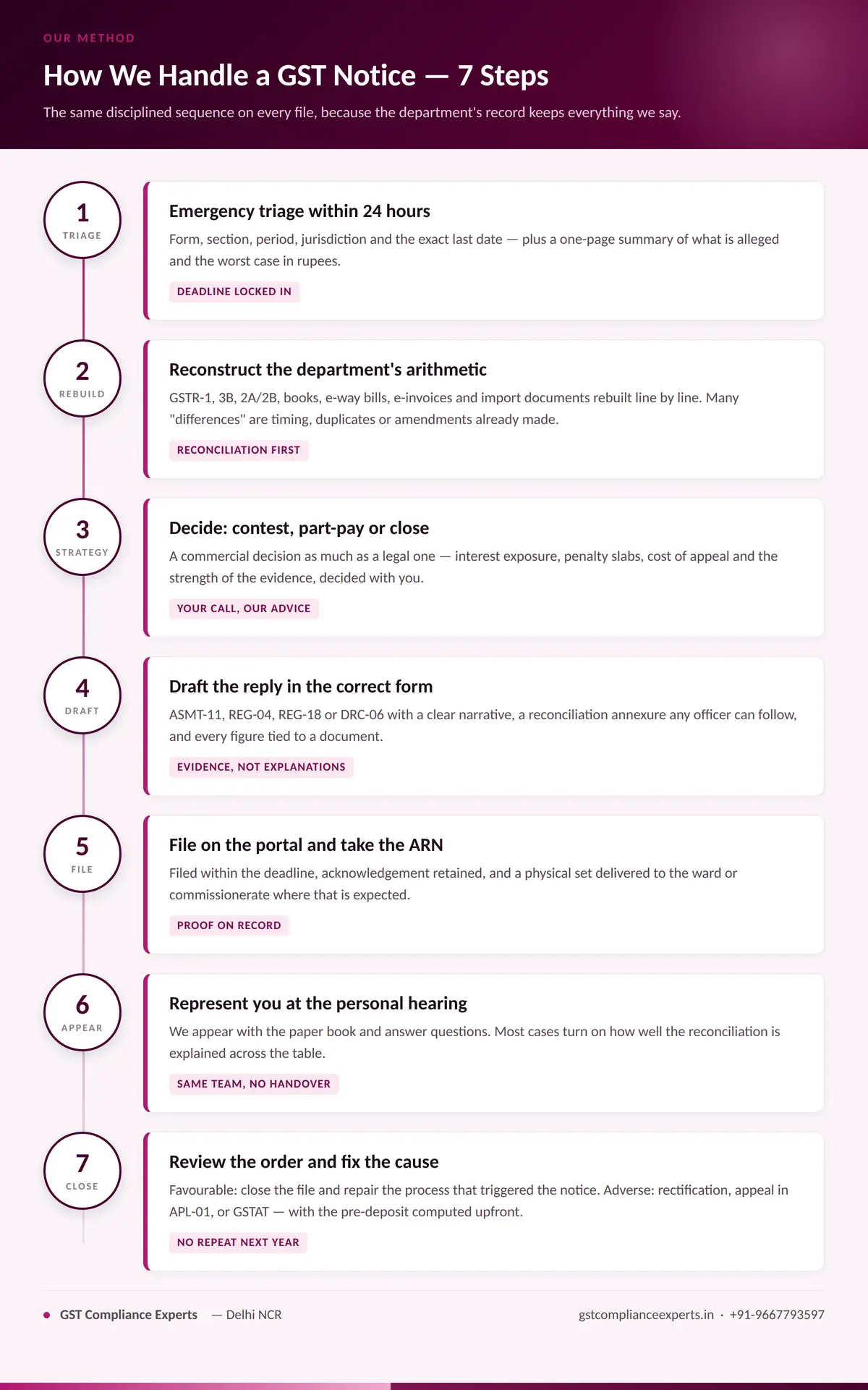
How to Respond to a GST Notice

While detailed drafting is case‑specific, the basic approach is:

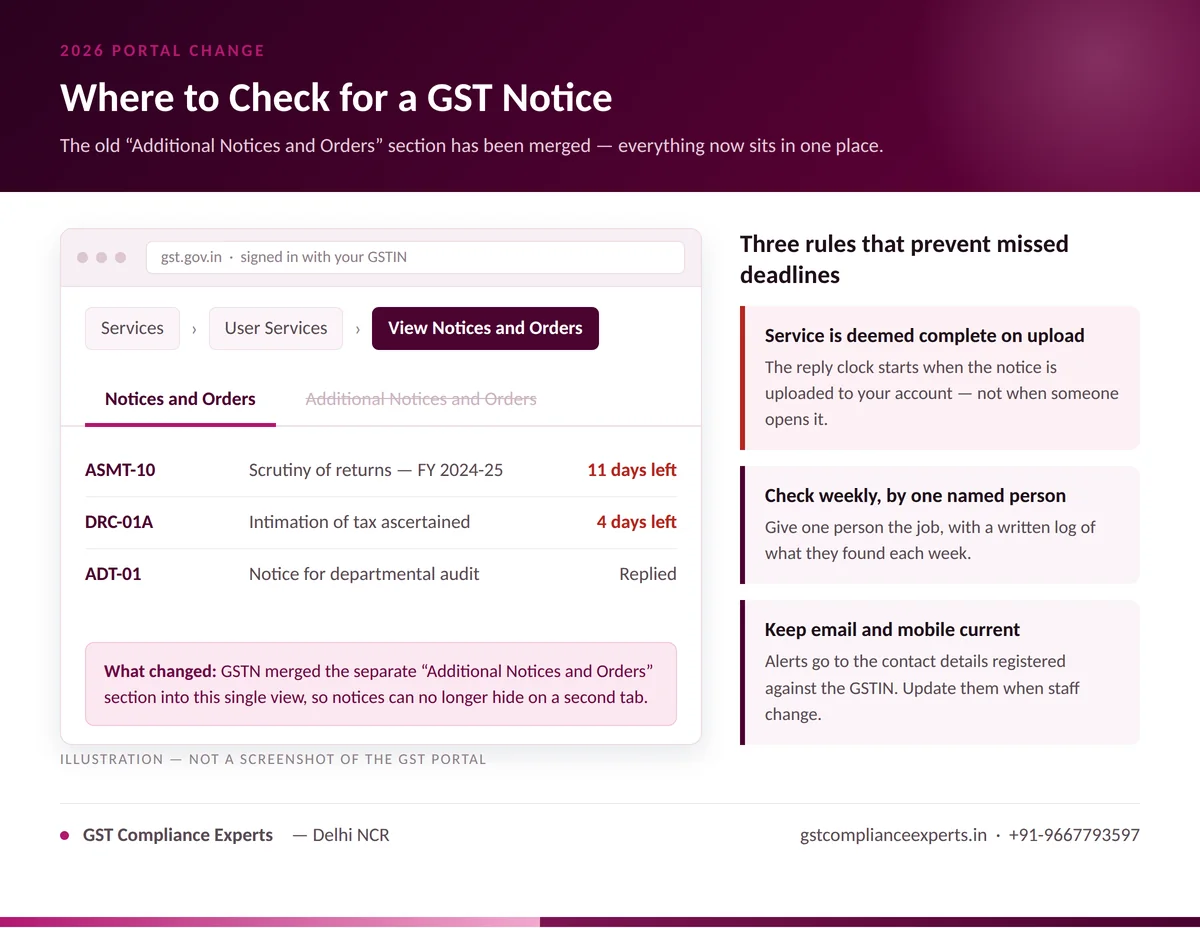
  1. Download the notice from the GST portal and read it carefully.
  2. Identify the issue (mismatch, default, ITC, or demand).
  3. Collect supporting documents (invoices, payment proofs, earlier returns).
  4. Prepare a structured reply explaining why the notice should be withdrawn or reduced.
  5. Submit the reply within the due date (usually 30 days).
  6. If needed, appear personally or through a GST expert for hearings or appellate stages.

For high‑value or complex notices, professional help from a GST notice reply expert can significantly improve your chances of a favorable outcome.

How GST Compliance Experts Can Help with GST Notice Reply Services

When a GST notice arrives, you can either handle the reply yourself or get expert support. GST compliance experts specializing in notice reply services provide:

  • Notice decoding – they explain the exact issue, risk level, and likely outcome.
  • Data and record verification – checking inconsistencies between your books, GST portal, and invoices.
  • Professional GST notice reply drafting – preparing a legally sound, evidence‑based reply to protect your interests.
  • Representation in hearings – appearing before GST officers or appellate authorities on your behalf.
  • Negotiation support – seeking reduction of demand, interest, or penalty where possible.

For MSMEs, startups, e‑commerce sellers, and professionals in Delhi NCR and across India, getting GST notice reply services from experienced compliance experts not only reduces stress but also minimizes financial loss and strengthens your GST compliance profile over time.

By understanding GST notices and responding through expert support, you turn a potentially stressful event into a controlled, compliant response that safeguards your business.


Contact ‎‎+91-9667793597

🌐 Visit: https://gstcomplianceexperts.in/


connect with taxation legal Advisor