
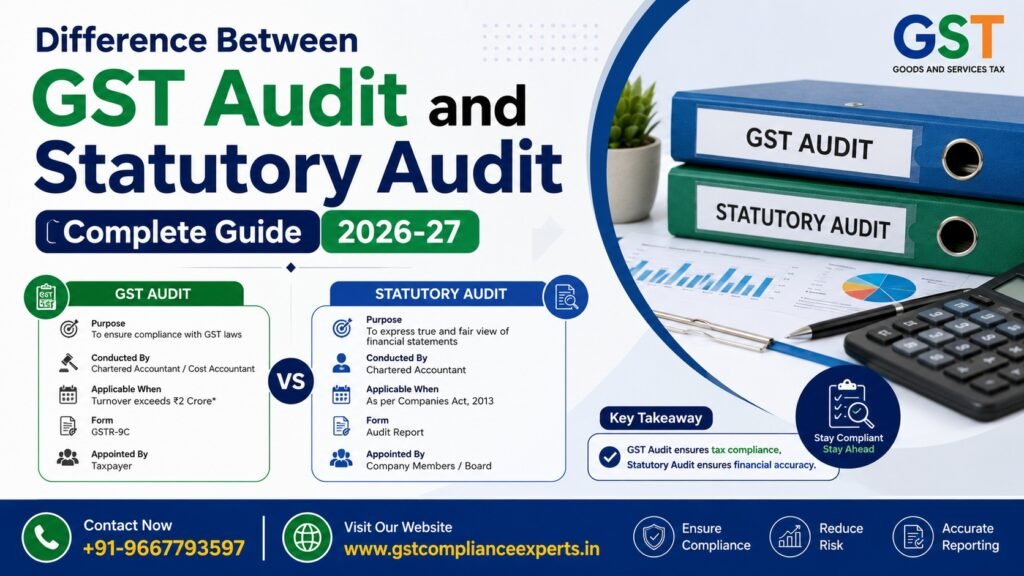
Difference Between GST Audit and Statutory Audit: Complete Guide 2026-27
Introduction
Many businesses in India are subject to multiple audits under different laws, and confusion between their scope and purpose often leads to compliance mismatches, notices, and avoidable litigation. If you’re wondering about the difference between a GST audit and a statutory audit, this comprehensive guide will clarify everything you need to know.
Understanding the distinctions between GST audit and statutory audit is critical for effective compliance planning. Each audit serves a distinct statutory objective, and knowing when each applies ensures your business stays compliant across all regulatory frameworks.
What is a Statutory Audit?
Statutory Audit is a mandatory audit required by law for all companies registered under the Companies Act, 2013. As the name suggests, this is a statute-based audit that is compulsory regardless of turnover.
Key Features of Statutory Audit:
- Governing Law: Companies Act, 2013 (or other statute governing the entity)
- Applicability: All Private Limited and Public Limited companies
- Objective: Ensure a true and fair view of financial statements
- Focus Areas: Accounting standards, internal controls, disclosures, asset verification
- Auditor: Chartered Accountant (CA)
- Report Addressed To: Shareholders and regulators
- Key Filings: AOC-4, MGT-7/MGT-7A
- Nature: Mandatory for all companies (not conditional on turnover)
The statutory audit examines whether all disclosures and compliance have been made in accordance with the Companies Act. It provides an opinion on whether the financial statements present a true and fair view of the company’s financial position.
What is GST Audit?
GST Audit is conducted under the Goods and Services Tax (CGST) Act, 2017. It verifies whether a business has complied with all GST rules and regulations, correctly declared turnover, paid taxes on time, and availed eligible input tax credit (ITC).
Important Update:
In the Finance Act 2021, Section 35(5) of the CGST Act was amended to remove the compulsory statutory audit requirement under GST. This was notified in CGST Notification No. 29/2021–Central Tax dated 30th July 2021, effective from 1st August 2021.
The compulsory audit was replaced with a self-certified Form GSTR-9C statement for taxpayers whose turnover exceeds ₹5 crore.
Key Features of GST Audit:
- Governing Law: CGST Act, 2017
- Applicability: Registered taxpayers with aggregate turnover exceeding ₹2 crore (previously mandatory; now replaced with GSTR-9C for >₹5 crore)
- Objective: Verify the correctness of turnover, taxes paid, refund claimed, ITC availed, and GST compliance
- Focus Areas: ITC eligibility, tax liability calculations, reversals, disclosures, return reconciliation
- Auditor: Chartered Accountant or Cost Accountant (for GSTR-9C self-certification)
- Report Submitted To: CBEC (Central Board of Excise and Customs)
- Key Filings: GSTR-9 (Annual Return) and GSTR-9C (Reconciliation Statement for >₹5 crore)
- Nature: Conditional (based on turnover)
The audit under GST examines whether all disclosures and compliances align with the GST Act and whether taxes have been duly paid.
Key Differences: GST Audit vs Statutory Audit
Here’s a comprehensive comparison to understand the difference between GST audit and statutory audit:
| Basis of Difference | Statutory Audit | GST Audit |
| Governing Act | Companies Act, 2013 | CGST Act, 2017 |
| Applicability | All companies (Private Ltd & Public Ltd) | Registered taxpayers with turnover > ₹2 crore |
| Condition | Mandatory for all companies (not turnover-based) | Conditional based on turnover |
| Primary Objective | Ensure a true & fair view of financial statements | Verify GST compliance, tax payments, and ITC correctness |
| What It Covers | Accounting standards, internal controls, disclosures, assets, and liabilities | Turnover declared, taxes paid, refunds claimed, ITC availed, return reconciliation |
| Focus Areas | Financial accuracy, accounting compliance, stakeholder protection | Tax liability, ITC eligibility, reversals, and GST return accuracy |
| Auditor Type | Chartered Accountant (CA) | Chartered Accountant or Cost Accountant |
| Report Submission | Shareholders and regulators (MCA) | CBEC (via GST Portal) |
| Key Forms/Filed | AOC-4, MGT-7 | GSTR-9, GSTR-9C |
| Nature | Mandatory | Conditional (turnover-based) |
| Turnover Limit | No turnover limit (all companies) | Previously ₹2 crore; now GSTR-9C for > ₹5 crore |
Applicability Criteria: When Does Each Audit Apply?
Statutory Audit Applicability:
✓ All Companies: Every entity registered under the Companies Act as Private Limited or Public Limited
✓ No Turnover Threshold: Applies regardless of business size or turnover
✓ Annual Requirement: Must be conducted every financial year
✓ No Exemptions: The presumptive taxation scheme doesn’t apply to companies
GST Audit Applicability (Current Provisions):
✓ Turnover-Based: Applied where aggregate turnover exceeds prescribed limits
✓ Previously: Mandatory for turnover > ₹2 crore (removed from Aug 1, 2021)
✓ Current: Self-certified GSTR-9C required for turnover > ₹5 crore
✓ Department Direction: Audit can be conducted if the GST department directs any taxpayer for audit, regardless of turnover
Objectives: Different Purposes of Each Audit
Statutory Audit Objective:
The main purpose is to provide shareholders, regulators, and stakeholders with confidence that the company’s financial statements are accurate, comply with accounting standards, and present a true and fair view of the financial position.
GST Audit Objective:
The purpose is to assess compliance with GST law, verify that:
- Turnover declared in returns matches actual business turnover
- Taxes have been correctly calculated and paid on time
- Input Tax Credit (ITC) availed is eligible and correctly reported
- Refunds claimed are legitimate
- All GST disclosures align with the books of accounts
Scope and Coverage: What Each Audit Examines
Statutory Audit Scope:
- Verification of/assets and liabilities
- Validation of income and expense recognition
- Compliance with Accounting Standards (AS/Ind AS)
- Internal control system evaluation
- Disclosure adequacy in financial statements
- Corporate governance compliance
- Board resolution implementation
GST Audit Scope:
- Reconciliation of books with GSTR-1, GSTR-3B, GSTR-9
- ITC eligibility verification (Rule 37, 37A, 42, 43, 17(5))
- Tax liability calculation accuracy
- Export and inward supply verification
- Reverse Charge Mechanism (RCM) compliance
- Refund claim validation
- HSN code correctness
- Timing of supply verification
Report Submission: Where Does Each Audit Report Go?
Statutory Audit Report:
- Submitted to: Shareholders first, then filed with the Ministry of Corporate Affairs (MCA)
- Forms: AOC-4 (Financial Statements), MGT-7 (Annual Return)
- Public Access: Available on the MCA portal for public viewing
GST Audit Report:
- Submitted To: CBEC via GST Portal
- Forms: GSTR-9 (Annual Return), GSTR-9C (Reconciliation Statement)
- Public Access: Not publicly available; only accessible to the GST department
Current Status: Is GST Audit Still Mandatory?
Important: This is a crucial point of confusion for many businesses.
Before August 1, 2021:
- Mandatory GST Audit: Required for all taxpayers with turnover > ₹2 crore
- Audit by: Chartered Accountant or Cost Accountant
- Form: GSTR-9C (certified by CA/Cost Accountant)
After August 1, 2021 (Current):
- Compulsory GST Audit Removed: Section 35(5) amended
- Current Requirement: Self-certified GSTR-9C for turnover > ₹5 crore
- No Mandatory Audit: Patients with turnover ≤ ₹5 crore don’t need a CA-certified audit
- Department Audit: The GST department can still conduct an audit of any taxpayer if needed
However, statutory audit under the Companies Act remains fully mandatory for all companies.
When Can the GST Department Conduct an Audit?
Even though compulsory GST audit by a CA has been removed, the GST department can conduct an audit of any registered person under Section 66 of the CGST Act if:
- Turnover exceeds prescribed limits
- Tax input credit availed is unusually high
- Tax liability declared is unusually low
- Refunds claimed are excessive
- Violation of GST provisions is detected
- Department directs audit based on risk assessment
Expert Tips for Managing Both Audits
1. Maintain Consistent Records
Ensure books of accounts are consistent across financial statements, income tax filings, and GST returns. Inconsistencies trigger audit queries.
2. Start Early
Audit preparation should not be year-end firefighting. Maintain continuous compliance throughout the year.
3. Reconcile Regularly
- Reconcile GSTR-2B with GSTR-3B monthly
- Match books with GSTR-1 quarterly
- Verify ITC eligibility before claiming
4. Document Everything
Keep proper documentation for:
- All invoices (outward and inward)
- ITC supporting documents
- Export declarations
- RCM transactions
- Refund claims
5. Seek Professional Help
For businesses with turnover > ₹5 crore or complex transactions, engage a GST compliance expert or CA for GSTR-9C certification.
Common Mistakes to Avoid
| Mistake | Impact | Prevention |
| Treating both audits as the same | Compliance gaps | Understand differences clearly |
| Missing reconciliation between books and GST returns | GST notices | Monthly GSTR-2B reconciliation |
| Incorrect ITC claims | Penalty + Interest | Verify eligibility before availing |
| Ignoring statutory audit (for companies) | MCA penalties | Conduct annual statutory audit |
| Late GSTR-9C filing (>₹5Cr) | Late fees | File before December 31 |
| Not updating HSN codes | Compliance issues | Use correct HSN consistently |
Penalties for Non-Compliance
Statutory Audit Non-Compliance:
- MCA Penalties: Up to ₹10 lakh for company, ₹25,000-₹1 lakh for officers
- Default Surcharges: Additional fees for late filing
- Legal Action: Possible prosecution under the Companies Act
GST Audit/Compliance Non-Compliance:
- Late Fees: ₹50/day for GSTR-9/9C (max ₹5,000)
- Interest: 18% per annum on unpaid tax
- Penalty: Up to 100% of the tax amount for fraud
- Audit Trigger: Higher risk of GST department audit
When to Seek Professional GST Compliance Help
Consider GST Compliance Experts if:
✓ Turnover exceeds ₹5 crore (GSTR-9C mandatory)
✓ Complex GST transactions (exports, RCM, interstate supplies)
✓ High ITC claims requiring verification
✓ Received GST notices previously
✓ Unsure about ITC eligibility or reversals
✓ Want to avoid compliance errors and litigation
Conclusion
Understanding the difference between GST audit and statutory audit is essential for proper business compliance in India. While a statutory audit is mandatory for all companies under the Companies Act, focusing on financial statement accuracy, GST audit (now replaced with self-certified GSTR-9C for >₹5 crore turnover) focuses on GST compliance and tax correctness.
Key Takeaways:
| Point | Statutory Audit | GST Audit |
| Mandatory For | All companies | Turnover > ₹5 crore (GSTR-9C) |
| Governing Law | Companies Act, 2013 | CGST Act, 2017 |
| Objective | Financial statement accuracy | GST compliance verification |
| Current Status | Fully mandatory | Self-certified for >₹5 crore |
Both audits serve different regulatory objectives. Proper alignment of books, returns, and disclosures across statutes helps mitigate litigation risk and ensures seamless compliance.
For assistance with GST audit compliance, GSTR-9/9C filing, or general GST compliance, contact GST Compliance Experts for professional support
